
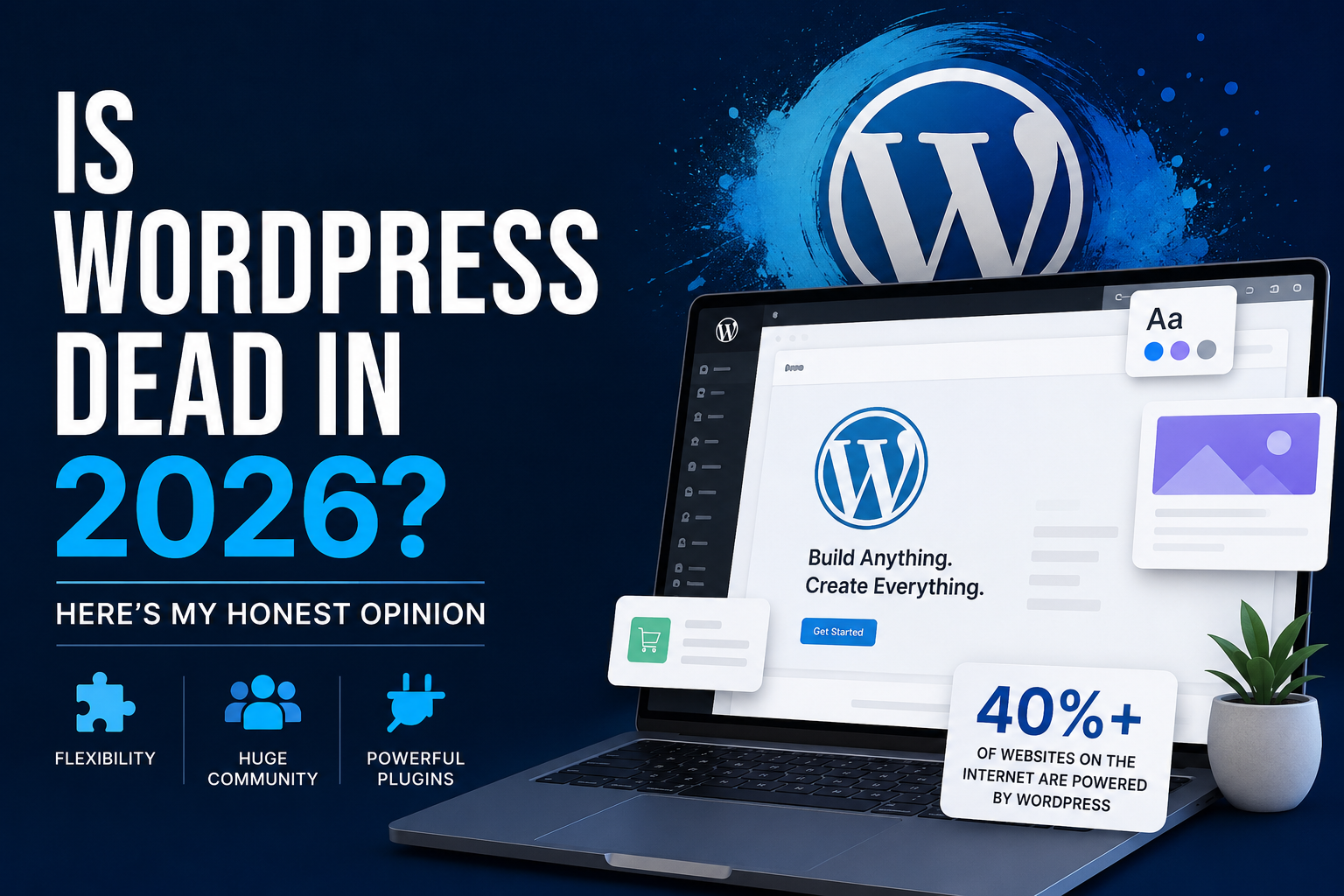

If you’ve been researching website platforms recently, you’ve probably seen people claiming that WordPress is dead. With AI website builders, Webflow, Framer, Shopify, and other modern platforms becoming more popular, it’s a reasonable question to ask.
So, is WordPress dead in 2026?
My answer is no.
As someone who runs a WordPress agency and builds business and eCommerce websites using Elementor, I believe WordPress is still one of the best platforms available for many businesses. While website development has changed significantly over the last few years, WordPress continues to offer flexibility, scalability, and a massive ecosystem that keeps it relevant.
Why Do People Think WordPress Is Dead?
Several factors have contributed to this belief.
The Rise of AI Website Builders
AI has changed how websites are created. Today, platforms can generate an entire website from a simple prompt within minutes.
This makes website creation faster than ever before, especially for basic websites.
New Website Platforms
Platforms like Webflow, Framer, and Shopify have become increasingly popular because they offer modern interfaces and simplified workflows.
As more people adopt these platforms, many assume WordPress has become outdated.
However, popularity doesn’t automatically make one platform better than another.
Our Experience With WordPress
We run a WordPress agency and primarily build business and eCommerce websites using Elementor.
Like many developers, I also considered switching to Webflow. After exploring it, I decided to continue using WordPress because it’s the platform I know best.
Having experience with WordPress allows me to work more efficiently, customize websites based on client requirements, and deliver reliable results.
For me, choosing a platform isn’t about following trends—it’s about choosing the right tool for the project.
Why WordPress Is Still Relevant in 2026
1. Flexibility
One of WordPress’s biggest advantages is its flexibility.
It Works for Different Types of Websites
Whether you’re building:
- A business website
- A blog
- An online store
- A portfolio
- A service-based website
WordPress can handle all of them.
Unlike many website builders, you’re not limited by the platform as your business grows.
2. Huge Plugin Ecosystem
Plugins are one of WordPress’s strongest features.
Thousands of Features Without Starting From Scratch
Need to add:
- Contact forms
- SEO tools
- Security
- Booking systems
- Memberships
- WooCommerce
- Performance optimization
There are plugins available for almost every requirement.
This helps save development time while allowing businesses to add new functionality whenever needed.
3. Massive Community Support
WordPress has one of the largest communities in web development.
Help Is Always Available
Millions of developers, designers, bloggers, and business owners use WordPress every day.
That means there are:
- Tutorials
- Forums
- Documentation
- Free resources
- Premium themes
- Premium plugins
If you encounter a problem, someone has probably already solved it.
The Biggest Challenge for WordPress
WordPress isn’t disappearing.
Its biggest challenge is AI.
AI Makes Simple Websites Easier
AI website builders can generate a basic website in minutes.
For individuals who only need a simple online presence, this is becoming an attractive option.
Professional Businesses Need More
Businesses usually require more than a basic website.
They need:
- Better SEO
- Custom functionality
- Scalability
- Professional branding
- Complete ownership
- Future flexibility
This is where WordPress continues to stand out.
Who Should Choose WordPress in 2026?
I still recommend WordPress for:
Small Businesses
Businesses that need a professional website capable of growing over time.
Agencies
Agencies managing multiple client websites benefit from WordPress’s flexibility and extensive ecosystem.
Bloggers
WordPress remains one of the best content management systems for publishing articles and managing blogs.
eCommerce Stores
With WooCommerce, WordPress continues to be an excellent solution for selling products online.
Is WordPress Still Popular?
Yes.
According to industry statistics, over 40% of all websites on the internet are powered by WordPress.
That makes it the most widely used content management system in the world.
A platform powering millions of websites isn’t dead.
It’s continuously evolving.
WordPress vs AI Website Builders
AI Wins for Speed
AI builders are great when you need a simple website quickly.
They reduce the time needed to create layouts and basic pages.
WordPress Wins for Long-Term Growth
When businesses need:
- Greater customization
- Better scalability
- Advanced functionality
- Thousands of integrations
- Full ownership of their website
WordPress remains one of the strongest choices available.
Our Final Opinion
Is WordPress dead in 2026?
No.
The competition has become stronger, and AI has changed how websites are built.
However, WordPress still offers unmatched flexibility, an enormous plugin ecosystem, and one of the largest communities in web development.
For small businesses, agencies, bloggers, and eCommerce stores, I believe WordPress continues to be one of the best platforms available.
Instead of asking whether WordPress is dead, ask yourself a better question:
Is WordPress the right platform for my business?
For many businesses, the answer is still yes.
For success stories. Visit ITISH.
For Services. Visit Services
You can visit and see the clients’ websites at: CCTVNation
For any other queries. Visit Contact